With competitions and society days coming thick and fast the green staff are working hard making sure the course looks its best. In this post I hope to paint a picture of what happens in an average week at this time of the year.
Monday
Aerate greens (star slit)
Brush greens
Cut greens
Cut tees, move tee markers
Rake bunkers
Cut tee banks
Spray selective weedkiller on fairway areas
Mole control
Weed granite dust paths
Pick up range balls
Tuesday
Cut greens
Top dress greens
Drag mat greens
Move hole positions, fill out pin sheet
Rake bunkers
Verti-cut green surrounds and approaches
Cut green surrounds and approaches
Cut semi-rough
Cut rough
Pick up balls from range
Wednesday
Iron greens
Rake bunkers, move tee markers
Cut rough
Cut semi-rough
Fill scars and pick up divots on fairways
Paint 150 yard markers
Cut hedges around clubhouse and car park
Rake and seed turf nursery areas
Fertilise previously seeded nursery areas
Pick up balls from range
Thursday
Cut greens
Flymo bunker faces, rake bunkers, move tee markers
Cut rough
Cut semi-rough
Cut fairways
Trim around sprinkler heads and distance markers
Check sprinkler head performance
Cut hedges at roadside
Move putting green hole positions
Strim around tee plates, steps, ball washers etc
Pick up balls from range
Friday
Brush greens
Cut greens
Iron greens
Rake bunkers
Divot tees, empty bins, fill ball washers and move tee markers
Mole control
Fill out pin sheet for Saturday
Cut tees
Cut green surrounds and approaches
Weed and top up granite dust paths
Pick up balls from range
Saturday
Cut greens
Move hole positions
Rake bunkers
Move tee markers
Pick up range balls
Sunday
Cut greens
Rake bunkers
Move tee markers
Pick up range balls
Of course, this is just a sample of the type of work we carry out in an average week in May. As you might expect we spend a large chunk of our time working on the greens. You might be surprised to learn we spend almost as much time maintaining bunkers. Many of the tasks mentioned above are repeated every week but others are only carried out periodically. In other weeks we may well carry out different types of aeration such as solid tining or deep slit tining and different areas will have fertiliser applied or be sprayed. Also countless one-off tasks arise which need to be addressed, sometimes these are the jobs that take the most time.
Wednesday, 20 May 2009


Wednesday, 8 April 2009
Spring Maintenance Week
Our first annual spring maintenance week commenced on the 30th March. I'm happy to report that all planned tasks were completed successfully despite a frost delay on the Monday morning lasting three hours. Thankfully no further frosts were seen during the week and scarification, overseeding and top-dressing work took place.
The main task carried out was overseeding of greens, this takes place to improve the overall grass species composition in the sward. Three varieties of Fescue grass were used. These particular plants have the ideal characteristics for golf green purposes and increased numbers of fescue grasses will dramatically improve the year round conditions on the greens.
Having identified the need for new seeding equipment last year and following a lengthy evaluation process we finally purchased a new seeder in March of this year. The Vredo Super-Compact seeder chosen represents a significant investment by the club but one which will benefit the golf course for many years to come.
 The new seeder on the 9th green
The main task carried out was overseeding of greens, this takes place to improve the overall grass species composition in the sward. Three varieties of Fescue grass were used. These particular plants have the ideal characteristics for golf green purposes and increased numbers of fescue grasses will dramatically improve the year round conditions on the greens.
Having identified the need for new seeding equipment last year and following a lengthy evaluation process we finally purchased a new seeder in March of this year. The Vredo Super-Compact seeder chosen represents a significant investment by the club but one which will benefit the golf course for many years to come.
 The new seeder on the 9th green
The machine works by using two rows of metal discs spaced 35mm apart which make thin slits in the turf into which the grass seed is delivered. The rear roller then passes over the slits causing them to close up to reinstate the playing surface. This method ensures the seed is placed to the correct depth and that good seed/soil contact is achieved. Seed wastage is kept to an absolute minimum using this method and given the costs of high quality sportsturf seed mixes this can only be a good thing.
 The metal discs making the cuts into the turf
 The seed lies safely in the bottom of these slits
 The metal discs making the cuts into the turf
 The seed lies safely in the bottom of these slits
The lines in the turf in the photo above will shortly be full of newly emerged young grasses so management practices will be tailored to ensure these are protected in the short term.
We plan to overseed greens at least four times each season using this method. During periods of good growth and following an application of top dressing the slits disappear very quickly and surface uniformity is not compromised. In the coming months and years the machine will be used for seeding other areas of the course such as weak fairway areas, walkways and roughs.
We plan to overseed greens at least four times each season using this method. During periods of good growth and following an application of top dressing the slits disappear very quickly and surface uniformity is not compromised. In the coming months and years the machine will be used for seeding other areas of the course such as weak fairway areas, walkways and roughs.
Friday, 20 March 2009
Irrigation
In the coming months one of the most important tools the course staff will use is the irrigation system. Our system was manufactured by Rainbird and was installed in 2007/8 by MJ Abbott. It covers all greens, tees, surrounds, fairways, some rough areas, turf nurseries and the chipping area. There are six boreholes which keep the 1 million gallon capacity reservoir topped up.
 1 million gallon reservoir
Three large pumps distribute the water around the course at a pressure of 150 psi through a network of pipes up to the irrigation sprinkler heads. The system has been designed to ensure that water is applied accurately and wastage is kept to a minimum. Low trajectory sprinklers are used in the most exposed spots to ensure the wind has a minimal impact. A central computer located in the maintenance facility is used to program and run the system.
 Mission control!
The course has been mapped using GPS with every sprinkler head, valve and pipe marked. Any sprinkler head can be turned on either at the base station, manually at the head or by using a remote control unit. The system can be programmed to run any number of heads in any sequence starting at any time.
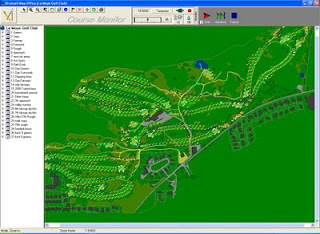 Course map as seen on the system display
 Zoomed in view of hole 1, chipping area, 9th green and 8th tee
Record keeping is made easy with this system as it automatically maintains detailed records of application timings and quantities giving weekly, monthly or annual aggregated totals. A weather station is also linked in to the system providing real time data of wind speed and direction, precipitation, humidity and temperature. From this information evapo-transpiration rates are calculated which the system can use to determine how much water should be applied to maintain optimum soil moisture levels.
 Daily weather records are automatically maintained
 1 million gallon reservoir
 Mission control!
 Course map as seen on the system display
 Zoomed in view of hole 1, chipping area, 9th green and 8th tee
 Daily weather records are automatically maintained
As you can see, our system makes it easy for us to apply water accurately and at the rates we want. However, we must remember that this does not mean we always want the golf course to be green and lush. Inappropriate and overuse of the irrigation system can cause serious long term problems to turf which can take years to rectify. We aim to use the system only when the health of the desirable grass plants would otherwise suffer, not just to soften the greens so the ball is easier to control or to green up the fairways to make them look "nice".
In late winter and very early spring we rarely irrigate even in extended dry periods because the cold water only serves to lower soil temperatures causing what little growth we have at that time of the year to stop completely. Much better dry, firm and slow growth than moist, soft and no growth! We generally irrigate in all dry spells throughout the mid-spring/early summer period to ensure the turf has optimal growth conditions to recover from the stresses of winter. Once mid summer comes we will relax the irrigation to allow the turf to dry out somewhat in order to stress the undesirable grass species and to encourage the fine grasses to develop deep rooting. Without doing this the shallow rooting grass species - which also happen to be the least suitable grasses for golf - are allowed to colonise and take over the sward. In general terms we are trying to present firm and consistent surfaces which have a dense cover of fine grasses. Our watering strategy is tailored with this in mind so please don't be surprised if surfaces get a bit brown in colour come mid summer, it will not mean the irrigation system is broken, we will merely be letting nature take it's course!
For more information on this topic please click on the title word IRRIGATION at the top of this post.
In late winter and very early spring we rarely irrigate even in extended dry periods because the cold water only serves to lower soil temperatures causing what little growth we have at that time of the year to stop completely. Much better dry, firm and slow growth than moist, soft and no growth! We generally irrigate in all dry spells throughout the mid-spring/early summer period to ensure the turf has optimal growth conditions to recover from the stresses of winter. Once mid summer comes we will relax the irrigation to allow the turf to dry out somewhat in order to stress the undesirable grass species and to encourage the fine grasses to develop deep rooting. Without doing this the shallow rooting grass species - which also happen to be the least suitable grasses for golf - are allowed to colonise and take over the sward. In general terms we are trying to present firm and consistent surfaces which have a dense cover of fine grasses. Our watering strategy is tailored with this in mind so please don't be surprised if surfaces get a bit brown in colour come mid summer, it will not mean the irrigation system is broken, we will merely be letting nature take it's course!
For more information on this topic please click on the title word IRRIGATION at the top of this post.
Wednesday, 18 March 2009
Broken Tee Pegs
 The broken tee pegs picked up from the course today
In an attempt to keep the golf course as litter free as possible, we are aiming to address the issue of broken tee pegs. Every m onth we spend many hours picking up broken tee pegs from the tees. Not only do they look unsightly but they also knock the mowers off cut, potentially causing damage to the grass itself. To try to combat this one of the tee markers on each of the tees has been replaced with a tee caddy (see pic. above). It is hoped that all players will use the tee caddy to deposit their broken tee peg after they have played their shot thus maintaining a tidy appearance to teeing grounds and helping to keep our mowers sharp and correctly set to ensure minimum injury to the grass plant.
 onth we spend many hours picking up broken tee pegs from the tees. Not only do they look unsightly but they also knock the mowers off cut, potentially causing damage to the grass itself. To try to combat this one of the tee markers on each of the tees has been replaced with a tee caddy (see pic. above). It is hoped that all players will use the tee caddy to deposit their broken tee peg after they have played their shot thus maintaining a tidy appearance to teeing grounds and helping to keep our mowers sharp and correctly set to ensure minimum injury to the grass plant.
Friday, 13 March 2009
The Start Of A New Season
The start of a new season is almost upon us and the greenkeeping team are working hard preparing the course for the season ahead. One of the biggest challenges we have ahead of us is getting the new bunkers ready for play. When the bunkers were being refurbished in the winter some of the sand is removed and this now must be returned to the bunker. Before the sand goes back in it is screened to remove any debris then it is put in the bunker and shaped to form the ideal bunker base. Next it is compacted to try to reduce the likelihood of balls plugging in the sand then finally it is raked to provide the perfect finish.
All bunkers are raked on a daily basis, it takes around two hours each day and more if shaping work is carried out, add to this the weeding and cutting work that takes place and we soon find ourselves putting in well in excess of 1000 man hours of bunker maintenance annually. All this for an area of the golf course that everyone tries to avoid!
All bunkers are raked on a daily basis, it takes around two hours each day and more if shaping work is carried out, add to this the weeding and cutting work that takes place and we soon find ourselves putting in well in excess of 1000 man hours of bunker maintenance annually. All this for an area of the golf course that everyone tries to avoid!
Tuesday, 10 February 2009
4th Hole Drainage

It has become clear in recent months that the drainage system under the 4th fairway was failing to do its job properly. There has been some debate amongst the course team as to the exact configuration of the drainage system and the reasons why it was failing. To address the problem the team set out to properly identify the location of the pipes, examine their condition and repair any damaged sections. Although old plans existed of the drain pipework it had been felt they were incomplete and did not tell the full story. Since accurate mapping was carried out on the golf course prior to the irrigation system being installed it is now possible for us to complete a more detailed plan of the drainage system.

More Tree Work
In keeping with our policy to manage the spread of the non-indigenous holm oak trees, we have embarked on the second phase of felling mature specimens.
Some trees have been removed from the bank that separates the 9th and 10th holes and more trees have been removed from the right hand side of the 18th hole. Due to the steep bank on the 18th a large excavator was used to move the felled trees into an area suitable for chipping to take place. Inevitably a certain amount of damage to the turf has occurred around the area where the excavator was working but this will be reinstated by course staff in the next few days.
Some trees have been removed from the bank that separates the 9th and 10th holes and more trees have been removed from the right hand side of the 18th hole. Due to the steep bank on the 18th a large excavator was used to move the felled trees into an area suitable for chipping to take place. Inevitably a certain amount of damage to the turf has occurred around the area where the excavator was working but this will be reinstated by course staff in the next few days.
 Excavotor moving a felled tree into position
The areas around the felled trees will be scraped back to bare sand/soil to allow the indigenous plant species space to re-establish. Please click on the ECOLOGY label at the bottom of this post to learn more about why we cut down trees and what we are trying to acheive.
Tuesday, 13 January 2009
Winter Course Closures

The unusually cold weather recently has meant the golf course has had to remain closed for most of the past three weeks. Whilst this is obviously frustrating for the members who wish to play, it is worth reminding ourselves why play is restricted when frost arrives.
Surface frost is basically frozen dew that has crystallised on the grass, making it hard and brittle. A grass blade is actually 90 percent water, therefore it also freezes. Because of the short mowing height (6.5mm at this time of year) and fragile nature of the turf, putting greens are most affected by frost. Walking on frost-covered greens causes the plant to break and cell walls to rupture, thereby losing its ability to function normally. When the membrane is broken, much like an egg, it cannot be put back together.
 The damage caused to the leaf of the grass plants during a surface frost is bad enough but the most devastating situation occurs following a hard penetrated frost when the grass blades and the upper portion of the soil profile has thawed, but the ground beneath their level remains frozen. Foot traffic on greens will create a shearing action of the roots and crown tissues and widespread plant death will occur. This is comparable to cutting the plant tissue from the underlying root system with a sod cutter.
 Hopefully the worst of the winter weather is now behind us and frost delays will soon be just a memory. The course has been protected during this vulnerable period and should show no adverse effects. The course staff can at last resume the various projects being worked on around the course and we can look forward to an exciting season ahead.
Wednesday, 10 December 2008
Bunker Renovation
For the past few weeks we have been refubishing the bunkers around the course. So far we have focused our efforts on holes 16, 17 and 18 with a total of 12 bunkers completed so far.
When planning bunker renovations there are a number of factors we take into consideration. Firstly the existing style of course bunkering is examined. We currently have a mix of "rolled in" turf bunkers and also sod stacked/revetted bunkers. We aim to develop a consistant style throughout the course and have decided to use the revetted style in all future bunker refurbishments.
Next we look at the position of the bunkers. With the advances in golf ball and club technology bunkers can become obselete. Before rebuilding any bunker we must decide whether the bunker is still best placed from a strategic perspective. Is the bunker still doing the job it was originally designed to do?
Finally we look at the bunker from an architectual perspective. Is it in keeping with the surrounding ground and the hole in general?, Does the bunker contribute positively to the aesthetic appeal of the hole?
If we are satisfied the bunker is in the correct location then we proceed with the work. If we decide that significant alterations are required, we will engage our golf course architect to carry out a detailed assessment before we proceed.
 2. Removing the old bunker face
 3. Digging out and shaping the surrounding ground
 4. Laying the first rows of turf to form the shape
 5. The finished bunker
When planning bunker renovations there are a number of factors we take into consideration. Firstly the existing style of course bunkering is examined. We currently have a mix of "rolled in" turf bunkers and also sod stacked/revetted bunkers. We aim to develop a consistant style throughout the course and have decided to use the revetted style in all future bunker refurbishments.
Next we look at the position of the bunkers. With the advances in golf ball and club technology bunkers can become obselete. Before rebuilding any bunker we must decide whether the bunker is still best placed from a strategic perspective. Is the bunker still doing the job it was originally designed to do?
Finally we look at the bunker from an architectual perspective. Is it in keeping with the surrounding ground and the hole in general?, Does the bunker contribute positively to the aesthetic appeal of the hole?
If we are satisfied the bunker is in the correct location then we proceed with the work. If we decide that significant alterations are required, we will engage our golf course architect to carry out a detailed assessment before we proceed.
Here is one of the bunkers from around the 18th green on the day worked commenced.
 1. Stripping turf from around the bunker
 1. Stripping turf from around the bunker
 2. Removing the old bunker face
 3. Digging out and shaping the surrounding ground
 4. Laying the first rows of turf to form the shape
 5. The finished bunker
All refurbished bunkers will remain out of play through the winter months. In late February the bunkers will have sand added and packed firm before being shaped properly ready for play. Please be aware that the depth of the bunkers will reduce considerably when the sand is added thus making player access easier.
Tuesday, 18 November 2008
Holm Oak Clearance
This week we have contractors on site clearing holm oak trees on holes 17 and 18 and from around the chipping area. The holm oak is an aggressive species which colonises areas rapidly if left unchecked. Once it gains a foothold it can turn an open landscape into woodland in a remarkably short space of time.
Holes 15-18 at La Moye are blessed with some of the best views to be found anywhere in Jersey. Unfortunately, over the years the unchecked spread of the holm oak has all but eliminated these views in some areas. In conjunction with our Ecological Management Plan we have embarked on a phased programme of holm oak clearance to open up the beautiful vistas we are blessed with. Some of the results are quite startling.
 View From 18th Tee Prior To Works
 View From 18th Following Clearance
There will be a large amount of clearing up to do once the contractors have left the site. We will reinstate the ground by scraping back to bare earth then seeding lightly with appropriate grasses. Holm Oak saplings will be removed as they emerge to ensure the area does not succumb to infestation in the future.
Holes 15-18 at La Moye are blessed with some of the best views to be found anywhere in Jersey. Unfortunately, over the years the unchecked spread of the holm oak has all but eliminated these views in some areas. In conjunction with our Ecological Management Plan we have embarked on a phased programme of holm oak clearance to open up the beautiful vistas we are blessed with. Some of the results are quite startling.
 View From 18th Tee Prior To Works
 View From 18th Following Clearance
There will be a large amount of clearing up to do once the contractors have left the site. We will reinstate the ground by scraping back to bare earth then seeding lightly with appropriate grasses. Holm Oak saplings will be removed as they emerge to ensure the area does not succumb to infestation in the future.
Subscribe to:
Posts (Atom)