Tuesday, 22 March 2016

A New Season

A New Season Begins

The past few weeks have been extremely busy for the course team in preparation for the start of the main golfing season. A persistent and frigid north-easterly wind has been causing some concern but hopefully now the worst has passed and temperatures will begin to rise. Most of our work has revolved around the Captains Drive In which was held on Saturday and making sure that the course is looking its best in these challenging conditions. We moved swiftly on from that competition straight into maintenance week which is now in full flow.

New Machinery

Last week the club took delivery of a pedestrian aerator which we believe will make huge improvements to our ability to maintain quality, healthy surfaces. The Toro Procore is the leading machine on the market and is already showing its quality in its first week on the job. After brief training due to user friendliness and maneuverability the Procore has been used this week to aerate the greens and surrounds in minimal time and with minimal disturbance. The machine is so fast that we have even been able to utilise it on other areas whilst waiting for other machinery to finish.


The team being trained on the Procore


We hope that this increase in speed and lack of disturbance will allow us to perform these operations more frequently with less interruption to play whilst continuing to improve playing surfaces.

Maintenance week

This years spring maintenance follows a similar plan to last year with the added bonus of the new machinery to our fleet. Following on from an application of lawn sand last week to control moss we began by scarifying the greens and surrounds in two directions to remove the dead moss and thatch buildup.

Scarifying 15th green

The organic material that has been removed

The surface showing scarifyer grooves


Once the greens had been scarified we followed with the Procore to aerate to a depth of around 3 inches. The greens were then ironed to avoid any compaction from the topdresser. The greens have been topdressed with straight sand which is brushed into the scarified grooves, aeration holes and fills any other imperfections in the surface and dilutes any thatch present.

Procore being used on the 13th green

Aerated surface ready for top dressing

10th green after top dressing
Now that the easterly winds have died down we hope that the soil temperatures will rise and spring growth will begin. Then we can resume our summer cutting regime and begin preparations for this years tournaments.

New Bunkers

The members will have noticed that the new bunkers on the 16th and 18th fairways are now open and ready for play. The addition of clean sand has given a good finish and we are very happy with all the  winter projects.

Clean sand added

The finished product


Ecology

Whilst we have finished with our big ecology projects of the winter we are still continuing work on this front. Some of the greenkeepers are involved in beginning to survey the species of birds present on the course which will be beneficial in tailoring our bird boxes. Raith Miller in particular is working hard on creating different types of boxes so that we can maximise the species present. Hopefully this along with the new sandy waste areas which can benefit species such as mining bees will allow the ecology of the course to flourish this summer.

Wednesday, 2 March 2016

Course Update

Course Update

Whilst the weather is yet to improve and we have had to deal with some high rainfall in the past few weeks, winter is coming to an end and the golfing season is fast approaching. This time of year is spent making the finishing touches to our construction projects, completing ecology works ready for spring and preparing the golf course for the coming season. I will touch on all of these points in this post and show the hard work the team has been doing in challenging conditions.

Course Maintenance

Both the greens and tees have been given their first verti-draining of the year with pencil tines to a depth of around 8". This is to improve air and water movement in the profile and has numerous benefits to plant health. This was followed by 10 tonnes of straight sand top dressing on the greens as part of  our on-going thatch dilution program. We have been managing the greens carefully throughout the winter with particular care to avoid excessive weight on the surfaces. A combination of hand cutting and ironing has allowed us to maintain performance even during the extreme wet weather.

Pencil tining greens


Applying sand top dressing to greens
The members will also notice that a cutting and scarifying operation has been completed around the 9th green. This bank had become rank with Ryegrass and any balls played into the area were more than likely to be lost. Now that it has been cut we will allow it to regenerate whilst managing it to avoid it again becoming too dense.

Construction

The flooding on the service track behind the 14th green has been a long running problem and having completed our tees construction we began work on resolving this issue. The track has been raised with hardcore, drainage sumps installed and the surrounding area returfed.

The finished product


Ecology

After the success of the sandy waste area created on the 8th carry, another area has now been established on the opposite side. The principle for this area has been the same however we did not have to bury as much gorse in the process and were careful to avoid some small heather plants in the surrounding vegetation.

Small heather plants amongst the existing vegetation

Before and after photos of the second area
As with the first area we have planted a mixture of natural sand dune species on the site including Marram, Dune rose and Bents. Creating these areas improves sustainability as they require little management, benefit the environment and speed up play as golfers are more likely to be able to find and play their shot. With the completion of these two areas we are starting to form a link between the front and back nines. Whilst La Moye will never again look as it did in 1902 when George Boomer first laid out his holes in the dunes, in the coming years we hope to return at least some of the course to its natural links pedigree. Notice the sandy waste bunker in the foreground of the photo below (Photo from 'The Boomer Legacy')


The 18th green in 1938


Tuesday, 9 February 2016

Weather Update

As I'm sure our members will have noticed, it has been quite a rough few days! Storm Imogen has caused disruption across the Channel Islands and we have not been spared. Fortunately damage has been kept to a minimum on the course however the 15th hole bore the brunt of the storm with two pine trees situated at the back of the green, a hawthorn at the tees and also the flag stick all being damaged. Now that the high winds have passed the clean up operation can begin with these damaged trees being the first to be cleared this morning.

Pine behind 15th green being cleared


Hawthorn at 15th tee

15th flag stick and hole cup damage
With wind speeds up to 75mph recorded in the island it is no surprise that we lost some trees however we believe that we got away lightly considering.

Friday, 29 January 2016

Ecology Update

This week as part of an ongoing ecology focus for the golf club we have been working on transforming an area of degenerate gorse on the 8th carry into a natural sandy waste area. This is part of continued work to improve the links characteristics of the golf course, improve sustainability and enhance species diversity.

The gorse in question was old, degenerate and encroaching on the carry which was blocking the view of the left half of the fairway. Hopefully members will now appreciate the improved view and also that we have managed to create an area of fantastic ecological significance at the same time.


These two photos show the original degenerate gorse.


The gorse was cut and removed for burning. This of course left the are open to regeneration however we wished to transform the area and not simply allow it to return to its original state.


The gorse stumps and roots were removed where there was not room for burying.


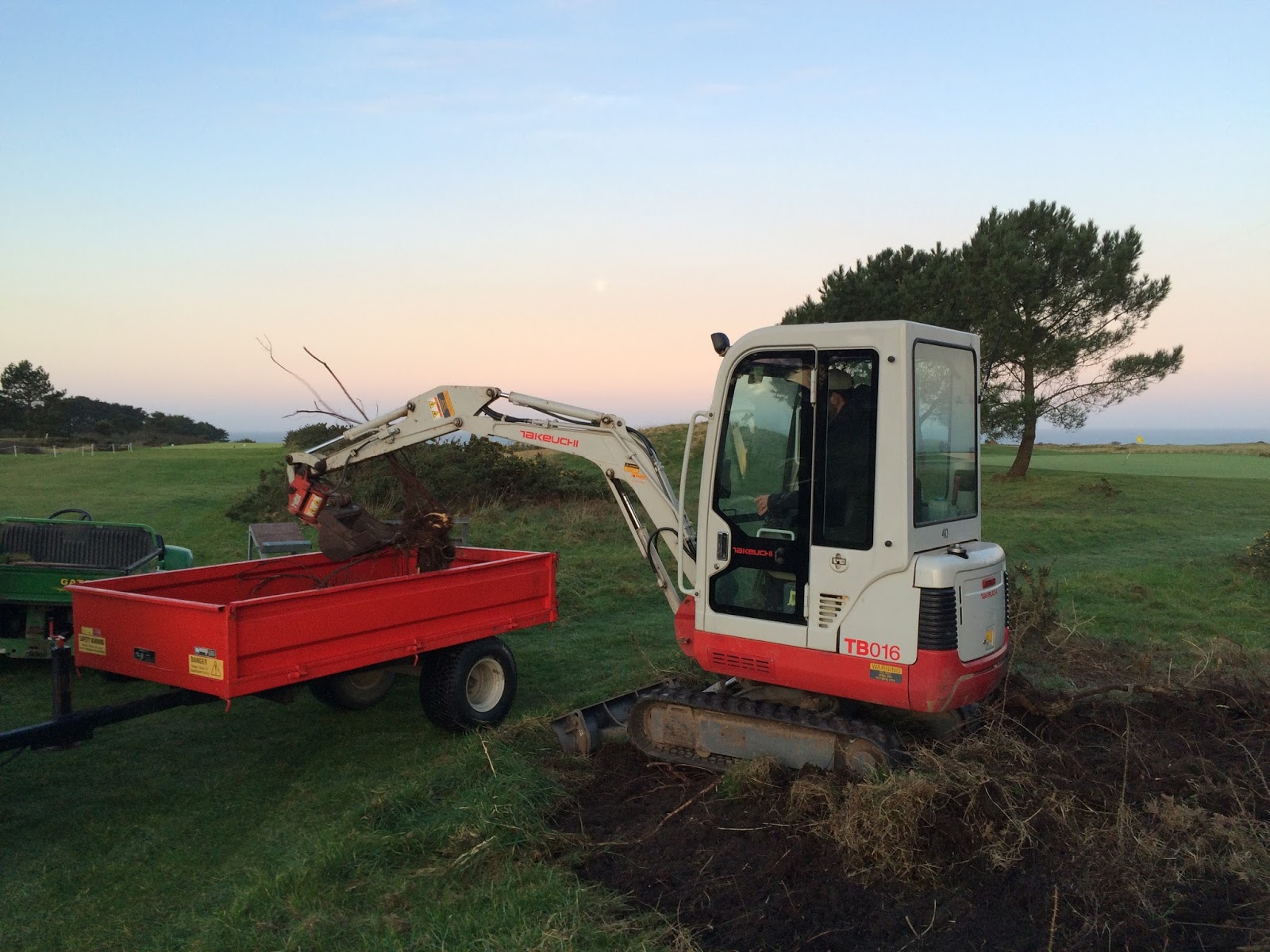
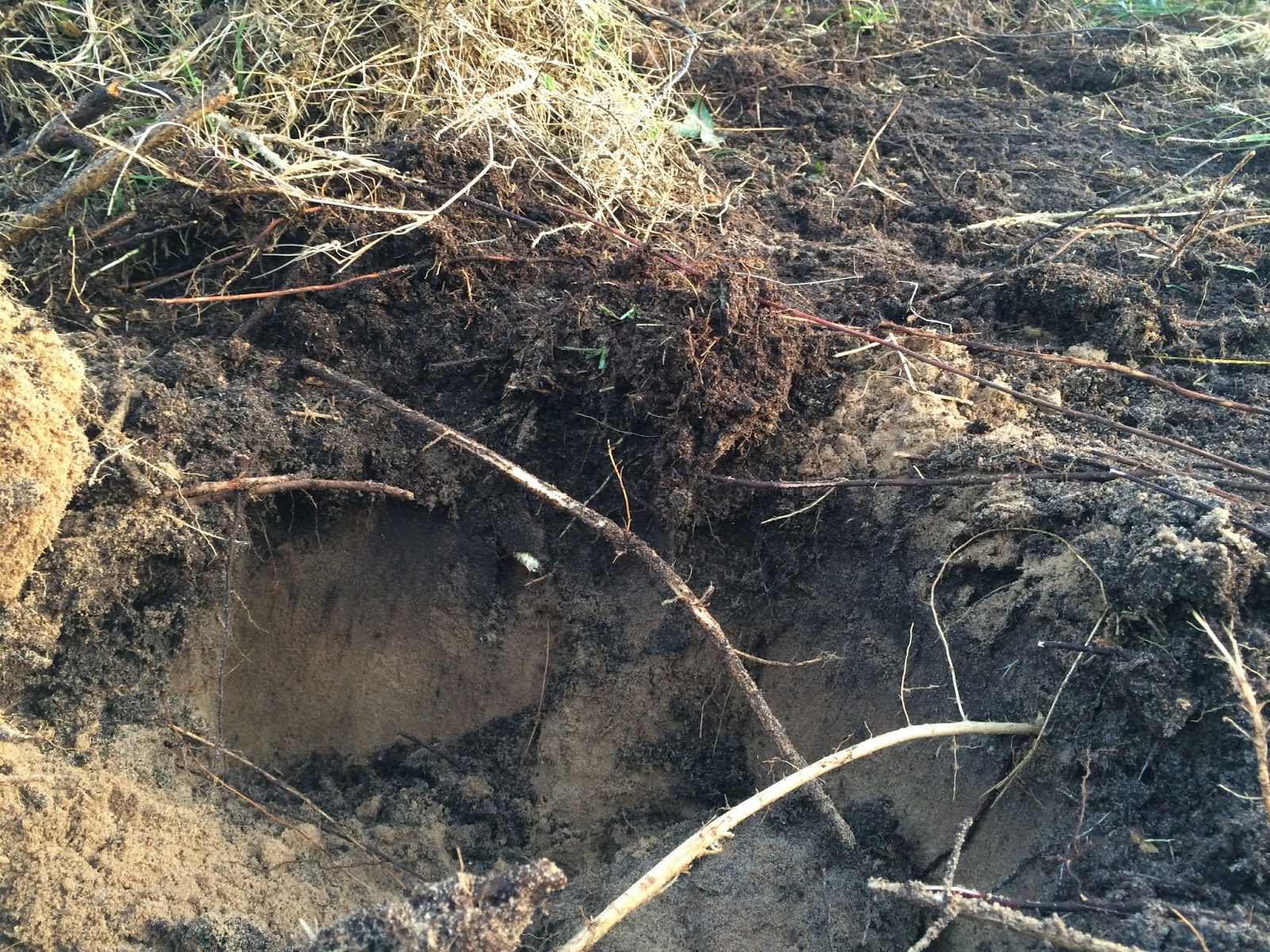
Where possible, holes were dug and the roots buried to prevent regrowth. The natural sand that was excavated was then replaced on top.


Clean sand was brought in from another area to give the area better presentation and improve the sand depth.


Natural dune species were then selected from other areas of the course. These included natural Fecsues, Bents, Dune Rose, Marram and Heather along with many others.


Some of the Marram was more efficiently transplanted using a front loader to dig out as much root as possible.


As you can see from these before and after photos the area has been truly transformed.


The area has gone from supporting a single mass of degenerate gorse to 20-30 different species of natural dune plants and grasses. This has improved the links characteristic of the hole and provided a great habitat for local species. The team are very proud of this work and hope that the members also appreciate the ongoing program of links restoration.

Friday, 8 January 2016

Winter Construction Update


Whilst the weather all over the UK hasn't been ideal to say the least, we have managed to make good progress with our winter projects this year. Members will have noticed that most of this work has concentrated on the 16th hole with some bunker construction also on the 18th and path end repairs over the whole course. 
We apologise for the current closures on the course however the rainfall has been extreme for the start of the new year and whilst we are currently verti-draining and using an air injection machine to combat the water, the sheer amount of water has necessitated some course closures.

16th hole progress

All three fairway bunkers on the 16th have been rebuilt this winter along with all of the tees. The bunkers have been raised so that there is less of a step into and out of the bunker and this should help members who are unfortunate enough to find themselves in the trap. 


The bunkers also had to be raised to that they were more visible from the new, lower tee complex.

Work on the tee complex has been time consuming as there was a lot involved in their construction. This was all neccessary as the railway sleeper wall had become unsafe. We also wished to remove the metal handrail as it was unsightly and blocked the stunning vista of St Ouens bay. 
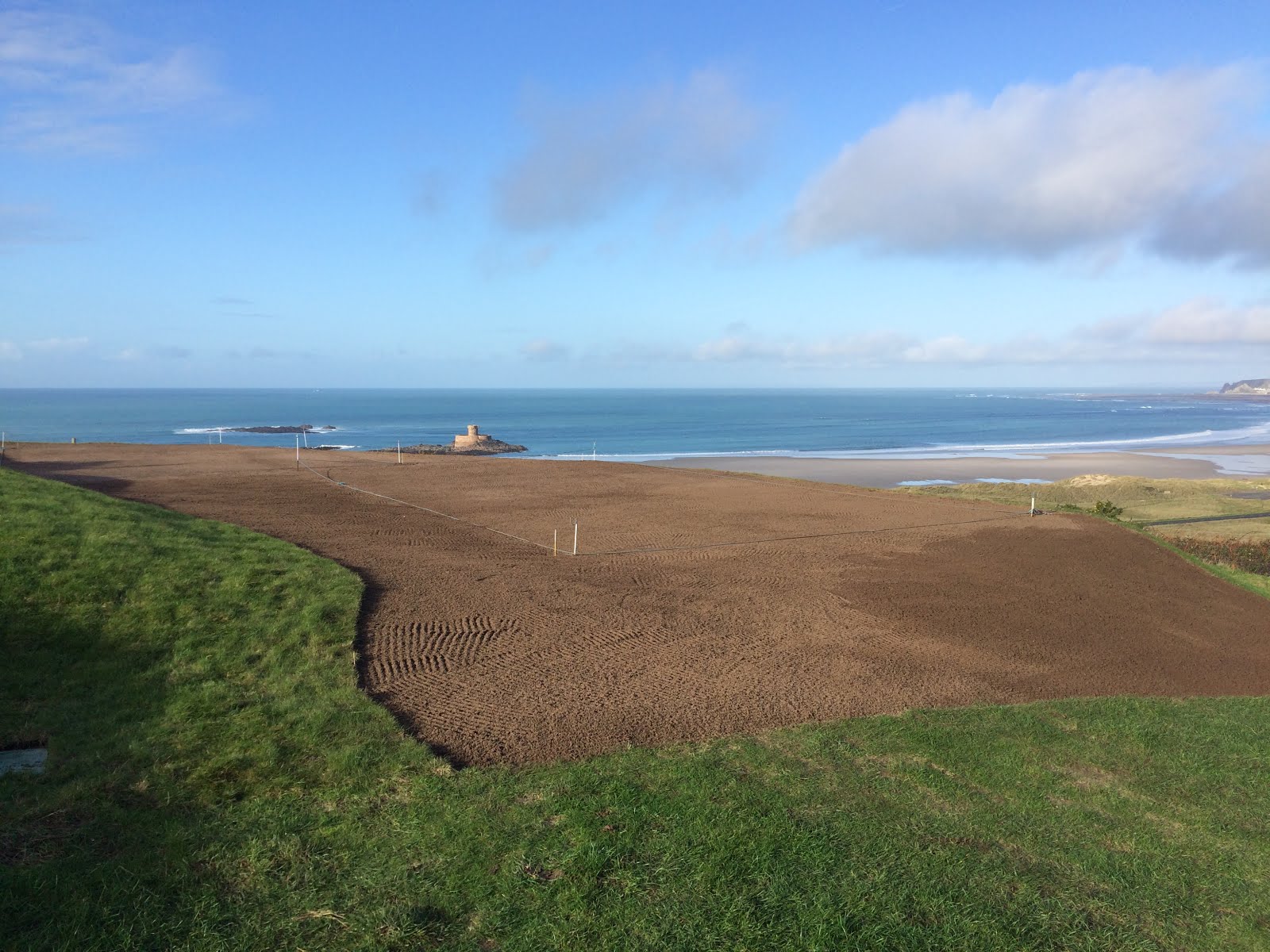
The white and yellow tees have both been lowered by around 3 feet, with the yellow tee being moved to the left giving a straighter line into the fairway. I believe the membership will agree that this has vastly improved the aesthetics of the tee and now gives an infinity effect over the bay. Members driving on the 5 mile road will also notice that the handrail is no longer visible from the bay.


All of this work on the mens tees meant that the ladies tee would also require relocating as it now blocked the view of the fairway. The next project was to lower and move the ladies tee to the left. 


The work on the ladies tee has improved views and also now fits better into the landscape without the sharp bank right in view from the mens tees.
The greenkeeping team now awaits the arrival of turf from the UK early next week. Once the areas have been turfed they will have a chance to root in preparation for the beginning of the golfing season.

Thursday, 12 November 2015

Brief Update

It has now been a month since maintenance week and we are seeing recovery from the greens along with good germination after our overseeding work. With the weather remaining unseasonably warm we are still seeing a fair amount of growth so our cutting regimes are still in full operation. This adds some pressure as we move into winter and begin our construction projects for 2016. Members will notice that we have already completed some path end repairs, with these areas being roped off for the time being to protect them as they root. The turf for these areas has been stripped from the 16th tees. Members I'm sure have also noticed that work is now well underway on this construction project. The original tee was constructed with a railway sleeper wall on the left side which had become unsafe and led to the tee subsiding. To remedy this the white and yellow tees have been lowered slightly and re-positioned so that a retaining wall is no longer necessary along with the unsightly railings. We hope that members will see the benefits in 2016 with improved views, a level teeing surface and a better line of sight to the fairway. The 9th ladies tee has also been stripped and re-leveled. I hope to bring you more news of our winter work as it progresses along with some photos to show the differences.

Yesterday was a nice, dry day so the decision was made to hand cut greens for the lady captains drive in. I shot this time lapse video of the 8th green being cut to give an idea of the process, I hope you enjoy it.


In the next update I hope to include some more photos and news of our progress.

Monday, 5 October 2015

Autumn Maintenance Week 2015

Having just completed this years Autumn maintenance work we would like to provide you with an update on the works completed and what we hope to achieve from these essential tasks. Given that it is becoming quite late in the year we have been very lucky with weather conditions this week. Soil temperatures have remained high enough to encourage germination and light winds have enabled the greens to dry quickly so that we could complete the tasks effectively. We hope that temperatures will remain stable in the next few weeks to give the seed its best chance to survive and germinate.

Pre Maintenance Work

Two weeks prior to maintenance week a graminicide was applied to the greens which targets the undesirable, coarse species of Ryegrass and Yorkshire Fog in the sward. This was completed using a pedestrian sprayer which was more time consuming but gave us greater accuracy of application. After ten days the greens were showing clear signs of the chemical taking effect. This may have caused some concern to members as the greens had turned a shade of brown! However this is normal as the chemical kills the coarse species but also causes temporary stress to the finer Bentgrasses in the sward. We were pleased to see that the Fescues remained healthy and noted the high percentage of this fine grass that was present in all the greens.

Maintenance Week

Greens

We began early on Monday morning by brushing the greens to disintegrate as much of the dead Ryegrass as possible before we began our main tasks. We then scarified the greens to a depth of 5mm to get into the thatch layer and remove organic material, making sure we carried the work on into the surrounds as much as possible.


Scarifying the 17th green.

A light top dressing was then applied and dragged into the slices cut by the scarifier. This is a major part of our on-going thatch dilution program which aims to improve water infiltration, surface firmness and ultimately greens performance.

Drag matting 17th green.
We next began overseeding the greens with fine fescue seed using the Vredo disc seeder. We did two passes on all greens and followed with a heavy top dressing to provide the seeds with soil contact which will protect the seed and aid germination rates. A total of 200kg of seed has been applied to the greens this week and we hope to see germination in the coming weeks. This increase in Fescue will improve our species composition leading to smoother, firmer and more sustainable greens. We hope the golfers will see the benefits in 2016.


The greens were top dressed again later in the week to fill in any remaining slots from the seeder and improve surface levels. A total of 40 tonnes of sand has been applied to the greens in just a week which brings us closer to achieving our target of 150 tonnes applied for the year.


8th green after renovations completed.


Approaches

After the work to the greens was completed we began some maintenance on the approaches. This included a double pass with the scarifier which removed a massive amount of thatch! (see picture) Followed by a single pass with the overseeder and a double pass with the top dresser. 40kg of seed and 9 tonnes of sand was applied.

Thatch removed from approaches.
Another pass with the overseeder and top dresser will be performed in the following week in another direction to improve species composition and firmness.

If you have any questions or comments please feel free to post below. We also now have a Facebook page which contains small updates and pictures of our work and can be used to ask any questions, so please 'like' the page if you are interested, see link below.
 La Moye GC Greens


Friday, 12 June 2015

Course Update


This update must of course start with an apology for the lack of posts since November! The greenkeeping team has undergone some major changes of personnel and roles in the past few months. First of all congratulations must go to both Richard Cutler on his new role on the Club's Management team and to Andrew Ricketts, our newly promoted Head Greenkeeper. Richard Le Moignan has also recieved a promotion along with myself to the position of Deputy Head Greenkeeper. With Richards' departure from the main greenkeeping team, he has passed on the updating of this blog to myself, (Matthew Amy) and Andrew. We hope to keep you informed about the ongoing maintenance and improvements at La Moye as diligently as Richard did. Now, I have a lot to cover since the last update so lets get started!

Winter Projects

As shown in the last post our major project this winter was the reconstruction of the 1st tee complex. This was completed in preparation for the captains drive in and we hope that the members are happy with the result. The old tee complex had been due for re-leveling for some time and so the opportunity was perfect to also increase teeing space on this short par 3. Members will notice that we have increased the surface area of the men's yellow tee by 50% which allows us to better spread the wear on the surface. 
Aesthetically the tee has been much improved by removing the old Elaeagnus hedge which had become aged and bare in places. The banking to the tee has been recreated using pure sand and replanted with Marram Grass (Ammophila). This native dune grass has been collected from other areas of the course and St Ouens sand pit, with the greenkeepers planting an estimated 2-3000 individual sprigs! The Marram Grass has been selected to give golfers an instant impact of the links character of La Moye on the first hole.

Newly turfed yellow tee on the 1st

Other winter work has included the rebuilding of some of the bunkers. Holes 10, 11, 12 and 18 have all seen renovation to their front left bunkers. The work completed on 11 and 12 saw a more extensive remodeling of the ground around the bunkers, which we believe has created a fairer obstacle for the golfers and made the bunkers look more natural in their positions.

Reconstructed bunker on 12th hole

Reconstructed bunker on 11th hole

Acorn Jersey Open 2015

After the completion of our winter program and the beginning of the main golfing season our preparations began for the arrival of the European Seniors Tour for the first time in five years. A program of regular verticutting and 'grooming' of the putting surfaces was put in place to refine the surface and remove the seeds of the Poa annua in the sward. This program is used every year for the benefit of the members and we saw especially good results this season with a prolonged period of dry weather. Two applications of top dressing were applied in the lead up to the tournament to improve surface levels and as part of our ongoing thatch dilution program. 
Greens were double cut and ironed every day of the tournament along with cutting the surround, approaches and tees. The greens performed brilliantly during the tournament with speeds beginning at 9.5 on day one and peaking at over 11 on the final round as the sun dried up the surfaces.
Perhaps the most marked improvement this year on the course has been the presentation of the fairways. The golf club invested in two John Deere 8000A Hybrid mowers and they began to pay dividends almost immediately. The fairways were cut regularly in different directions and the improvement in quality of cut from the new units has provided better ball roll and lies. For the tournament itself the fairways were cut every evening and we reverted to a 'block' pattern, which is more in keeping with the traditional links character of the course.
All of the greenstaff worked feverishly for the week before and during the tournament, putting in plenty of overtime to present the course to the highest standards. The comments we gratefully received from the professionals, spectators and members were fantastic and the whole team is very proud of their hard work. 


15th Green

Head Greenkeeper Andrew Ricketts changing holes on day 2

17th Green on final day

12th Green on final day
Next on our busy program for 2015 is the Natwest Island Games. Preparations for this tournament have already begun along with our day to day work maintaining the course for our members.