
Tuesday, 14 June 2011
Fertiliser Spreading
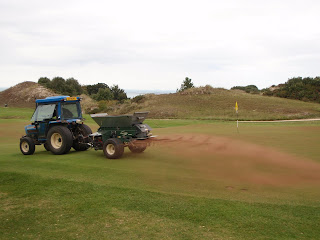
If you have been on the course today or plan to visit tomorrow you may notice a rather "organic" smell coming from the turf. Today we have been spreading a poultry litter based fertiliser product on a number of areas around the course to help boost turf health and encourage growth in high wear spots. Thankfully the smell will fade quickly but spare a thought for Andrew and Phil who had the unenviable task of spreading the stuff all day today!


Bird Box Survey
We have 18 bird boxes situated in trees and on some of the buildings around the golf course complex. In a survey carried out last month we found that 10 of the 18 boxes showed signs of being inhabited. In those 10, chicks could be seen or heard in 5 of the boxes.


Friday, 10 June 2011
Irrigation Priorities

We have been losing between 20 and 30mm of moisture from the turf each week from a process called evapo-transpiration. Although this does not sound too bad, to replace 25mm of water across the whole course means that we must apply around 1 million gallons of water. Consequently, we have been abstracting large quantities of water from our boreholes to replenish the water pumped from our reservoir.
In recent days it has been noted that the yield from the boreholes has decreased to the extent that we have been pumping water out of the reservoir and onto the golf course faster than we have been able to replace it. You may have noticed the low water levels in the reservoir recently whilst standing on the 14th tee. This is obviously an unsustainable situation and as we are still in the first half of the season with potentially a lot more dry weather ahead of us, we must now adjust our irrigation output to a sustainable level.
Currently two thirds of the water we apply is to fairways so clearly this is the area where the greatest savings can be made. It makes sense to prioritise the watering of greens, tees and approaches whilst reducing the amount of water the fairways receive. Instead of watering fairways every night, from now and until the next significant rainfall, we will water these areas on 2 or 3 occasions each week. This will ensure we will have enough water for the priority areas for the remainder of what could be an extraordinarily dry season.
Saturday, 14 May 2011
More Gorse Clearance

A few weeks ago we cleared more gorse from between the 4th and 5th holes. Degenerate, woody bushes were pulled out from around the trees to create a slightly more open feel to the right side of the 4th. A number of sharp rush plants can be found in this area but these were being severely compromised by the encroachment of gorse. During this process we tried to protect the sharp rush from damage.


Following the clearance work an excavator was used to scrape the brash from the ground to expose the natural seed bank beneath. This helps to accelerate the regeneration process.

Once recovery takes place we expect the area to contain a healthy balance of young gorse plants, sharp rush and open grasslands.


In time we will tackle the rest of the gorse between the 4th and 5th as it is all becoming well past its best.

Friday, 13 May 2011
Hole 8 Gorse Clearance
The rather old and tired looking stand of gorse to the right side of the 8th hole was recently removed. This had become very unsightly in recent years and had encroached into to to such an extent that visibility of the road that crosses the fairway had become severely restricted.
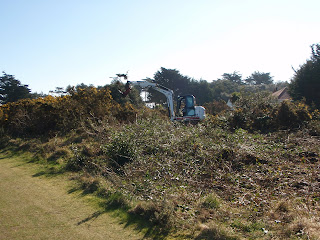

An excavator fitted with an attachment specially adapted for pulling gorse was selected to carry out the work. In only three hours a 40m x 8m stand of degenerate gorse mixed with bramble was removed and burned nearby.
As can be seen in the video below, the remaining material was mulched with a heavy duty flail fitted to a high powered tractor. This par of the job took a mere 30 minutes to complete.
Although this has left the area fairly clean and tidy, we will need to go back to treat the bramble re-growth in a few weeks.


An excavator fitted with an attachment specially adapted for pulling gorse was selected to carry out the work. In only three hours a 40m x 8m stand of degenerate gorse mixed with bramble was removed and burned nearby.
As can be seen in the video below, the remaining material was mulched with a heavy duty flail fitted to a high powered tractor. This par of the job took a mere 30 minutes to complete.
Although this has left the area fairly clean and tidy, we will need to go back to treat the bramble re-growth in a few weeks.

Wednesday, 4 May 2011
Course Update
Greens
The putting surfaces have performed reasonably well recently following the work carried out during the maintenance week. Micro-hollow tining, scarification and top dressing work was undertaken on all greens with the principle aim being to reduce organic matter (thatch) in the base of the sward.
Currently, Poa Annua grasses in the greens are seeding, causing surfaces to be slightly bumpy especially later in the day following the early morning preparation. When time allows, brushing the greens prior to cutting is being done to minimise the effects of this temporary condition. When the seeding subsides solid tine work on the greens will resume to maintain the efficient movement of air and water through the soil profile. Ironing is carried out around three times each week to further promote smooth surfaces.
Irrigation
Following exceptionally dry weather conditions throughout April, nightly irrigation is taking place on all areas of the golf course. Around 10mm of water is being applied across the course each week in an attempt to maintain a healthy balance of soil moisture in this early part of the season. Frighteningly, 10mm of irrigation across the course equates to around 400,000 gallons of water, which is more than one third of the reservoir pumped onto the golf course each week! Bearing in mind our irrigation water is derived from ground water with moderately high ph and bicarbonate levels and thus not as good for the turf as rain, it is little wonder that the course team are desperate for a good downpour.
Driving Range Sponsorship
We are delighted to announce that an agreement has been reached with Brewin Dolphin to sponsor the driving range. Brewin Dolphin are one of the UK and Channel Islands leading private client investment managers. Ten thousand new balls have been ordered along with some extra signage and we hope to have this all in place by end of June / early July.
Chipping Area Practice Tee
Essential maintenance work is currently being carried out on the practice tee at the chipping area. This work is necessary to reinstate the surface following the winter months when cold temperatures meant that no recovery from wear was possible. To hasten recovery, top dressing and overseeding work has been carried out and the tee will be closed for around two weeks. As an alternative, a practice mat has been situated behind the main tee to allow wedge shots to be played to the designated landing area.
Green Staff Safety
Following a number of near misses on the golf course in recent weeks players are reminded of our staff safety policy with regard to working on the course during play.
- Green staff have priority on the course before 9 am.
- If green staff are working on or around the green with the flagstick removed then players must wait until it has been replaced before playing to the green.
- At all times, staff will aim to cause a minimum of disruption to play and will only hold up play briefly and when absolutely necessary.
Any player who deliberately hits a ball to a green with a member of the course team clearly working on it and the flagstick removed will be reported to the Management Committee and will face disciplinary action.
Monday, 11 April 2011
Spring Maintenance
We recently undertook our spring maintenance week. This year we micro hollow cored the greens using a 3/8ths of an inch tine set to a depth of 3 inches. This procedure is aimed at reducing organic matter (thatch) in the soil.


Next, we scarified the greens. Again, the purpose of this work is to remove the build up of organic matter in the soils. Rotating brushes fitted to a greens mower were then used to pick up loose debris left on the green surface following the scarification.

Following this, all surfaces were top dressed. Around 22 tonnes of material was used in total to fill the tine holes and to reinstate surface levels.


Next, we scarified the greens. Again, the purpose of this work is to remove the build up of organic matter in the soils. Rotating brushes fitted to a greens mower were then used to pick up loose debris left on the green surface following the scarification.

Following this, all surfaces were top dressed. Around 22 tonnes of material was used in total to fill the tine holes and to reinstate surface levels.

Wednesday, 30 March 2011
Transplanting Pine Trees

We recently took the decision to transplant a few small pine trees which were planted a number of years ago on the left side of the fifth hole. As the trees have matured they have grown too close together to such an extent that they now compromise one another. We also felt that the trees could have a greater strategic impact within the hole if they were pulled back and spaced out so players who have hit left off the tee now have a more obstructed path towards the green.
Using a 16 tonne excavator we first dug out the soil from the areas where the trees were being replanted. As the soil in the area is of a very sandy nature we added a nutrient rich, moisture holding material to give the trees the best chance of surviving the process. We then turned the excavator bucket around and gently scooped up the root ball beneath the tree and placed each tree in the freshly dug holes.


The trees only have a moderate chance of surviving this process but the only alternative to this course of action was to cut them down completely. Hopefully with regular watering and a slice of luck they will establish successfully in their new location.
Tuesday, 29 March 2011
A Stunning Vista
Overgrown blackthorn bushes behind the 4th green have been drastically cut back recently. Over the years these plants had grown ever taller and closer to the green to such an extent that the spectacular views down towards La Pulente and beyond to Corbiere had long since disappeared.


During the process two granite outcrops were uncovered that add extra interest to the area. In future the blackthorn will be maintained at its present height and the exposed soil will be managed to encourage rough grasses.


During the process two granite outcrops were uncovered that add extra interest to the area. In future the blackthorn will be maintained at its present height and the exposed soil will be managed to encourage rough grasses.
Thursday, 10 March 2011
5th Green Bunkering - Pt 9 - Right Hand Side
Following the successful refurbishment of the three bunkers on the left side of the green it became clear that the two bunkers on the right would require the same treatment.


As usual, work started with an on-site discussion between some of the course team to establish our goals for the project. In this instance it was apparent that we needed to improve the ease of access into the first of the two bunkers. We also hoped to improve the visibility of the bunkers from the fairway but we realised that the contouring and flow of the bunkers and immediate surrounding areas could not be compromised along the way. We finally settled on improving player access and ensuring that the two new bunkers significantly improved the standard of presentation that is possible for the area. We agreed that making sure the new bunkers were consistent with the rest of the bunkers and green complex was fundamental to the success of the project.


Subscribe to:
Posts (Atom)