Following a vote carried out at the Special General Meeting held in the clubhouse on Tuesday 1st February, the plans to reconstruct the greens and associated areas on holes 10-12 will now go ahead. Work is scheduled to start in early October 2011 and should be completed in January 2012. All holes will reopen by May 2012 at the latest. Further news on this exciting project will be posted here in the coming weeks and months.
Sunday, 20 February 2011


February Course Update
Despite some difficult weather conditions, work on rebuilding and reshaping some of the most worn out bunkers has progressed well. The bunkers by the 5th and 14th greens and the two bunkers to the left side of the 1st green are now completely refurbished and will be back in play in time for the start of the new season. Some members have commented on the depth of the new bunkers, it should be noted that before they are reopened, these bunkers will each receive between one and three tonnes of sand to raise the level of the bunker floor. However, it is important that no sand is added until the bunker turf has knitted together so as to prevent the new turf from being damaged by sand blowout. Excessive levels of foot traffic can also damage the new turf so it is vital that these areas are protected at this crucial stage. Ropes, posts and hoops are used to guide players around these vulnerable areas and I would urge all members to please walk around not through and over the fences to ensure these areas are given every chance to survive these first few weeks when there is little or no grass growth.
Course Ecology
More Marram grass has been planted in the sand dunes between the 11th and 13th holes following the tree removal work of 2009. The areas remain highly sensitive to disturbance so please take care when retrieving balls from the marked areas so as not to disturb the young plants.
Work on the gorse around the course is due to start soon as per the Ecological Management Plan. Two or three clearings will be made in the band of gorse that runs between holes 4 and 5. The gorse in this area has become very woody and degenerate following many years of neglect. We plan to pull some of the oldest gorse plants out to make space for new young plants to establish and to allow space for the rather rare plant sharp rush to flourish. On hole 8, the gorse on the right side from the tee to the road will be tackled. This has also become rather degenerate over the years whilst also blocking the view from the tee of cars accessing the course due to the outward gradual encroachment of the gorse. Some of the trees in the area around holes 2, 4 and 5 will be felled in the coming weeks. Only a relatively small number of trees are planned for removal this winter following the much larger scale works carried out in previous years.
The stand of Blackthorn behind the 4th green is another area in need of attention. This shrub provides an important habitat for birds but it is also an aggressive species. Its growth and spread is in need of control so as to open up the views towards the coastline. In the coming weeks the plant will be cut back and trimmed down to a height of around 1 metre.
Aerating The Turf
Aeration is one of the most important maintenance tasks carried out on turf. The word aeration means quite simply to get air into something. In turf it is simply the production of holes through the turf surface into the underlying rootzone (soil) to allow gases (oxygen etc.) in and out of the soil and for water and grass roots to move down through the soil. Since October we have been running two verti-drain type machines over all areas of the course. Fairways and high wear walkways were tackled first, followed by greens and their surrounds. These machines allow us to make lots of holes in the turf and at sufficient depth to enable the movement of water more quickly through the soil beneath. The action of these particular machines also allows a certain amount of "heave" to be put on the soil. This lifts the level of the ground slightly allowing air and moisture to penetrate and relieve compacted areas. Compaction in the turf is caused by the regular movement of people or machinery over an area, wet soils compact more easily as the water in the soil acts as a lubricant allowing the particles to slide closer together and form a bond. We plan to make one further pass over the greens and surrounds with the verti-drain in the middle of February.
Other Upcoming Work
Before the start of the new golfing season we plan to strip the turf from the 16th tee in order to make adjustments to the surface levels. There has been a degree of settlement on one side of the tee over the years causing a noticeable sloping of the surface. This work will be completed and the turf sufficiently healed in time for the start of the new season.
Rabbits continue to cause serious problems. We are once again stepping up our control measures as we move into the early spring period. Repairs to the perimeter fence are taking place to ensure the populations in the surrounding land are kept out. A fairly large-scale rabbit hole patching programme will begin in the second half of February.
Blogging Resumed
Following an extended period of inactivity I intend to resume blogging with immediate effect. The following few posts will cover the main work that has been carried on the course since mid-December.
Saturday, 11 December 2010
Behind The Scenes
Have you ever wondered what the greenstaff do when the course is closed due to snow, frost or flooding? This post intends to give some insight into some of the unseen work that is routinely carried out by the maintenance crew.

The maintenance of machinery is an on-going requirement throughout the year but in the winter months thorough inspections and major overhauls are carried out to all plant and machinery. In the image above Gary and Matt are preparing cutting units for sharpening with our dedicated in-house cylinder grinding equipment.

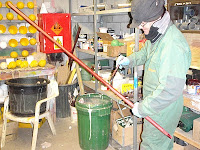
Re-painting of golf course equipment such as bunker rakes, tee markers and hole cups is another on-going requirement. We use six different colours of tee marker on the course and these need to be kept in good condition.
In total we have more than 200 tee markers and with 54 hole cups and more than 50 rakes we are never short of something to paint!
 We have many benches around the course most of which have been donated over the years by members or the families and friends of members who have passed. Each year they are removed from the course to be rubbed down and varnished to ensure they are kept in the best condition possible for as long as possible.
 Numerous other housekeeping tasks are attended to around the maintenance facility. The club invested heavily in the purpose built maintenance complex a number of years ago and we try to be diligent in our upkeep of the fantastic facility that we have. In the image above some of the block work from the yard has been lifted to remove tree roots.
Of course numerous other tasks are carried out regularly which have not been featured here, some of which we will highlight in future posts

The maintenance of machinery is an on-going requirement throughout the year but in the winter months thorough inspections and major overhauls are carried out to all plant and machinery. In the image above Gary and Matt are preparing cutting units for sharpening with our dedicated in-house cylinder grinding equipment.


Re-painting of golf course equipment such as bunker rakes, tee markers and hole cups is another on-going requirement. We use six different colours of tee marker on the course and these need to be kept in good condition.
In total we have more than 200 tee markers and with 54 hole cups and more than 50 rakes we are never short of something to paint!

 Numerous other housekeeping tasks are attended to around the maintenance facility. The club invested heavily in the purpose built maintenance complex a number of years ago and we try to be diligent in our upkeep of the fantastic facility that we have. In the image above some of the block work from the yard has been lifted to remove tree roots.
 Of course numerous other tasks are carried out regularly which have not been featured here, some of which we will highlight in future posts
Thursday, 2 December 2010


Sunday, 28 November 2010
5th Green bunkering Pt 8 - Completion
Last week we finally completed the work on the left side of the 5th green.
 |
| Before |
 | |
| After |
 | ||
| Before |
 | |||
| After |
 | |
| Close up |
 |
| 125yds from green |
Tuesday, 23 November 2010
5th Green Bunkering Pt 7
The past week has seen us make slow progress with work on hole 5. Bad weather, staff shortages and even a break-in at the greenkeeping complex have resulted in progress being slowed on the job that we had expected to have finished by now. So far we have completed the revetting work on the first two bunkers and around three quarters of the turfing has been carried out.

Some comments have been received about the depth and steepness of the revetted faces of the bunkers. I will deal with the depth issue first; sand still needs to be added to the new bunkers to bring it up to the finished level. In the case of the 2nd left hand bunker this amounts to a lot of material as this bunker floor is being raised by about a foot making the step in at the back of the bunker no more than about 10 inches. With regard to the steep angle of the revetted face, there have been requests to construct these at a 45 degree angle to the bunker floor. This would be inappropriate, revetted greenside bunkers should have an angle of between 60 and 70 degrees. This figure is arrived at for a number of reasons - it lessens the chance of sand coming to rest on the bunker face which ultimately kills the turf, it lessens the chance of a golf ball coming to rest on the bunker face which is a nightmare for golfer and greekeeper alike, it ensures that sand movement within the bunker is minimised as more protection is offered from the wind and finally a 60 degree angle of bunker face creates an appropriate penalty to the errant shot. The player always has the option of playing out of the bunker sideways or backwards if they feel unable to tackle the "steep" face directly.
Wednesday, 10 November 2010
Monitoring Groundwater
Yesterday we were visited by two employees of the States of Jersey Environment Department, Environmental Protection Division. The purpose of the visit was to test the quality of the water in our boreholes and to ensure no contamination is taking place from pesticides or other chemicals. Testing is carried out twice each year and involves testing the water on site for pH, conductivity, temperature and alkalinity. Samples are then taken back to the lab for further microbiological and pesticide analysis.


The results of the latest testing can be viewed on a pdf file by clicking here for reference, our boreholes are numbered J128a and J128B
If you would like to find out more about this topic you can visit the States of Jersey website by clicking here
Tuesday, 9 November 2010
5th Green Bunkering Pt 6
Following some delays due to fixtures and inclement weather, work has resumed at the 5th. 7 full days have passed since we began stacking the turf and as you can see from the image below we have laid it just in time. The yellowing of the grass has occurred because the plants have been deprived of sunlight for too long. Any longer and the grass would have died. Unsightly as it is at the moment, the grass will green up quite quickly and will suffer no lasting damage.

Bunker revetting is progressing well. We have now almost completed the first bunker and the other two have been started. We aim to have all three finished by Monday.

Andrew hard at work!
Thursday, 4 November 2010
5th Green Bunkering Pt 5
Today we finished shaping the base layer then we started to bring back in the top soil. The material was spread to an even depth and firmed up using a small tractor.


The raking of the top soil was carried out by hand. At this stage stage of the job attention to detail is critical to ensure a good end result. A good deal of skill is required to make sure the ground flows in the correct way with no unnatural looking slopes and smooth transitions from the existing turf. In the image above Ollie, Matt and Kev can be seen doing a good job of raking out the soil to get it ready for turfing.

The first piece of turf is laid on the finished surface by Kevin Le Farrell.
Meanwhile, the base layer in the first two bunkers was laid out. This largely dictates the final shape of the revetted wall so it is vital tthis is done correctly. The base of the bunker must also be level and firm to ensure the bunker remains stable for years to come.


Subscribe to:
Posts (Atom)