Tuesday, 9 November 2010

5th Green Bunkering Pt 6

Following some delays due to fixtures and inclement weather, work has resumed at the 5th. 7 full days have passed since we began stacking the turf and as you can see from the image below we have laid it just in time. The yellowing of the grass has occurred because the plants have been deprived of sunlight for too long. Any longer and the grass would have died. Unsightly as it is at the moment, the grass will green up quite quickly and will suffer no lasting damage.


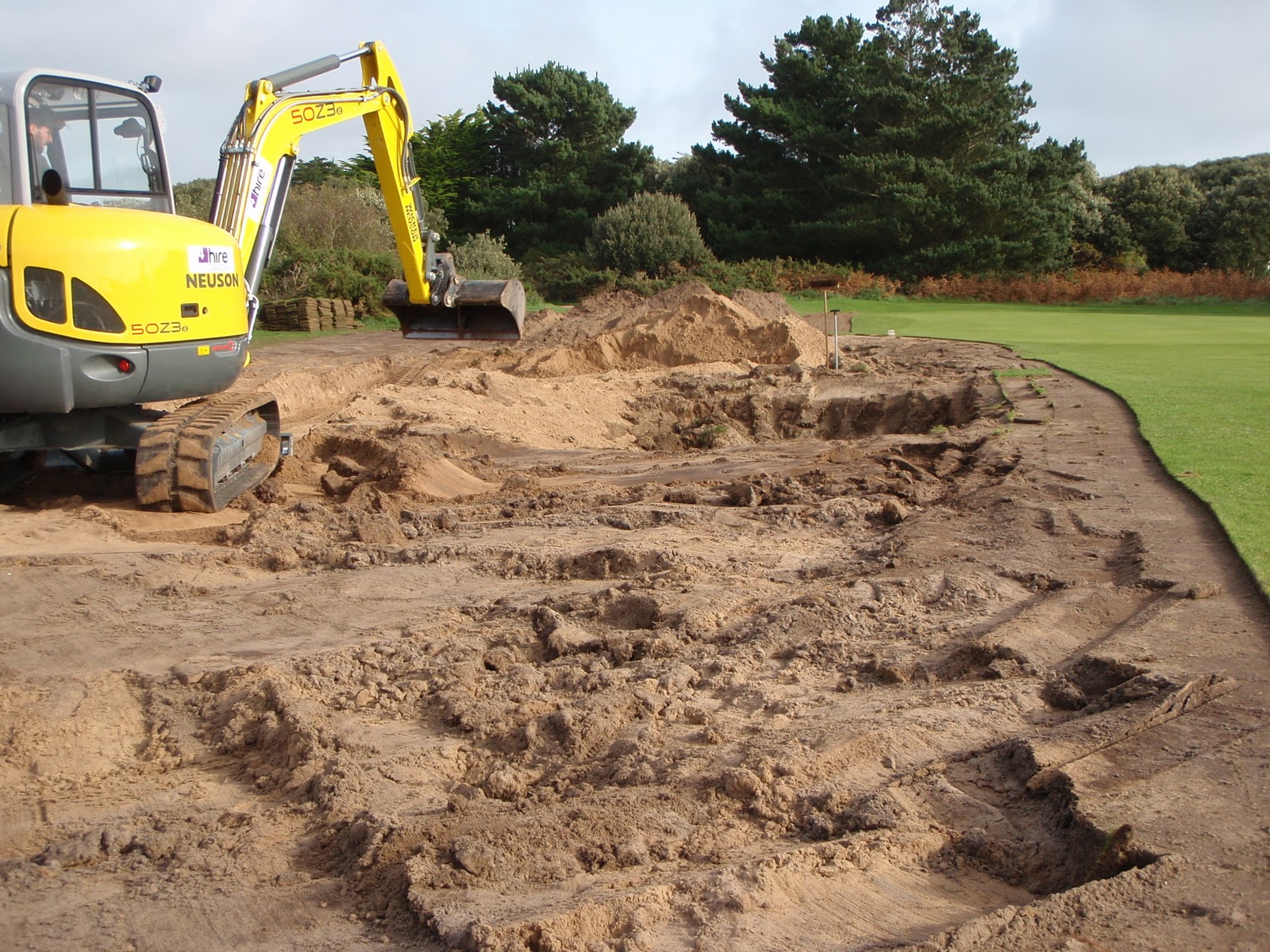
Bunker revetting is progressing well. We have now almost completed the first bunker and the other two have been started. We aim to have all three finished by Monday.

Andrew hard at work!

Thursday, 4 November 2010

5th Green Bunkering Pt 5

Today we finished shaping the base layer then we started to bring back in the top soil. The material was spread to an even depth and firmed up using a small tractor.


The raking of the top soil was carried out by hand. At this stage stage of the job attention to detail is critical to ensure a good end result. A good deal of skill is required to make sure the ground flows in the correct way with no unnatural looking slopes and smooth transitions from the existing turf. In the image above Ollie, Matt and Kev can be seen doing a good job of raking out the soil to get it ready for turfing.

The first piece of turf is laid on the finished surface by Kevin Le Farrell. 

Meanwhile, the base layer in the first two bunkers was laid out. This largely dictates the final shape of the revetted wall so it is vital tthis is done correctly. The base of the bunker must also be level and firm to ensure the bunker remains stable for years to come.


Wednesday, 3 November 2010

5th Green Bunkering Pt 4

Most of our day was spent removing excess sand from the site. Some shaping work was started around the first two bunkers.The stakes in the bunker were used to establish how high the revetted faces will need to be in order to see them clearly from the fairway. Incidentally, the height required is nowhere near the top of of the stakes! If you click on the image then zoom in you may just be able to see some yellow tape which is tied to the green and white post. The tape marks the approximate height of the top of the new bunker face.

Tuesday, 2 November 2010

5th Green Bunkering Pt3

The excavator arrived today allowing work to start on the removal and shaping of the soil. First of all we  scraped off the top soil and piled it up for use later.


We then spent the rest of the day removing sand to the desired levels. The excavator loaded  tractors and trailers with material that was dumped in an area adjacent to the 15th tee. This material will be mixed with composted material to form a sandy loam for future use.


Monday, 1 November 2010

5th Green Bunker Refurb Pt 2 - Turf Cutting & Removal

Today work started on the refurbishment of three bunkers on the left side of the 5th green. The area was marked out immediately prior to the turf cutter arriving on the scene.


The turf was cut using a 12 inch wide blade to a depth of 1 inch. It was sliced into pieces of 2 feet in length.  Of a total work area of 550m2 just over 50% of the turf will be reused. All reusable turf was lifted by hand and stacked to one side. 


 The remaining material, which was too weak to be lifted and relaid, was removed mechanically and taken to the composting area to be left to rot until ready for screening into divot mix. The shortfall in turf for this project will come from our nursery area at Corbiere.


We have an excavator on hire from tomorrow which will be used for digging out the bunkers and for rough shaping work on the surrounding ground.

Saturday, 30 October 2010

5th Green Bunker Refurbishment

Starting next week,we plan to refurbish the five bunkers around the 5th green. The bunkers on the left side of the green will be subject to fairly major reshaping work with the aim of making the bunkers more visible from the fairway,  improving aesthetics and making access and egress easier. 


As can be seen in the above image, the current look of the bunkers is rather uninspiring. The bunkering around this green should have a far greater visual impact so to achieve this we will remove material from the back of the bunkers and reshape the faces. We will use a revetted style of bunker face in keeping with the style on other areas of the course.
The image below shows extensive soil erosion at the point of exit from the bunker. This is caused by the steep slope which leads to people slipping and skidding as they try to get out of the bunker. Access to the bunkers will be greatly improved by the reshaping of the land at the point of exit from each of the bunkers.


Work is scheduled to start here on the 1st of November. To enable the work to proceed in a safe and timely manner it will be necessary to use a temporary green on non-competition days during the project.

Friday, 29 October 2010

Maintenance Week Update

Greens are recovering well from the work carried out during the maintenance week. Following a period of inclement weather we have managed to apply the final 20 tonnes of top dressing material to the putting surfaces. In all a total of 50 tonnes was applied in the ten days following the hollow core operation and the material has been worked into the sward nicely.
Germination of the new grass following the seeding operation is now clearly evident. Rows of new bent grass where the seed drill has passed over can be seen in the image below taken of recently of the 12th green.

Monday, 25 October 2010

More Marram Planting

Following on from the work carried out last year, we have planted more Marram grass (Ammophila arenaria) on the left side of the 11th hole. Since the Holm oak (Quercus ilex) trees have been removed from the dunes in this area we have identified the need to stabilise the shifting sands. There can be no doubt that Marram is perfect plant for this purpose. Recent heavy rain has provided ideal soil conditions so hopefully most of the plugs will establish successfully.


We carry out most of this work by hand. We carefully select the best plants then we tease them out of the ground and collect together in large tubs ready for replanting. Through trial and error we have found that the plants that survive the process best are those which have the most fresh looking small white roots. The large rhizome that extends deep from each plant does not help a transplanted specimen to survive. We would consider the plants shown in the image below to be ideal for transplanting as they have a good number of fresh looking root hairs.
  
Tiny root "hairs" clearly visible

We aim to complete as much of this type of work as possible over the next few weeks as this is felt to be the best time of year to ensure success. Areas on the left side of the 13th hole will be planted out next.


All planted areas have been white lined and fenced off. No play is allowed from within the lined areas and players are requested to take care not to trample the plants when retrieving their ball.

Sunday, 3 October 2010

Course Maintenance Week

Work scheduled for our autumn maintenance week has been completed on time. Hollow coring, verti-cutting, overseeding and top dressing work has been carried out to all 18 greens and surrounds and the two practice putting greens also.

Coring The 15th Green

Half Inch Holes With 2x2 Inch Spacing


Verti-Cutting On 15

Some Of The Material Removed During Verti-Cutting

Broadcasting Seed Into Tine Holes

Applying Top Dressing

Around 30 tonnes of dressing was applied to the putting surfaces. Once the material is fully worked in, another 20 tonnes will be applied. The holes will take 2-3 weeks to disappear.

Friday, 17 September 2010

Chemical Control Of Ryegrass in Greens Pt 2

 The Treated Collar On Hole 14
Following our initial application to the 4th and 6th greens last year, we have sprayed Pinoxadin on greens and collars on holes 1, 12, 14-18 and the putting green to control Ryegrass and Yorkshire Fog. We also re-treated the 4th and 6th to control the small amounts of Ryegrass re-growth that was evident. We expect to see significant die back of the target grasses in around the third week of September. Soon we will overseed the treated areas with bent grasses so hopefully the new grass will fill in the gaps left by the dying ryegrass. Top-dressing will take place to ensure surface smoothness is maintained but some brown patches will be evident for some time to come. This work has been timed to avoid major competitions but still get the benefit of the warm temperatures.